- PH: +91 8828443924
- Email: Response@ShrinithaFurnace.Com

Vacuum Furnace
Laboratory Vacuum Furnace Manufacturer & Exporter in India
Shrinitha Scientific is a manufacturer and exporter of Laboratory Vacuum Furnaces in India, specializing in high-temperature furnace solutions for research laboratories, material testing facilities, universities and industrial R&D applications.
Our Laboratory Vacuum Furnaces are designed with temperature capabilities ranging from 1000°C to 1650°C, depending on the selected model and configuration. These furnaces are suitable for controlled heat treatment, vacuum annealing, sintering, brazing, material processing, degassing and other specialized thermal applications.
A Vacuum Furnace provides a controlled heating environment in which air and other gases can be removed from the chamber to achieve the required reduced-pressure conditions. This is particularly useful when processing materials that are sensitive to oxidation, contamination or unwanted reactions with atmospheric gases.
Shrinitha Scientific offers application-oriented Vacuum Furnace configurations with suitable heating systems, temperature controls, vacuum arrangements and optional gas-handling provisions to meet different laboratory and industrial processing requirements.
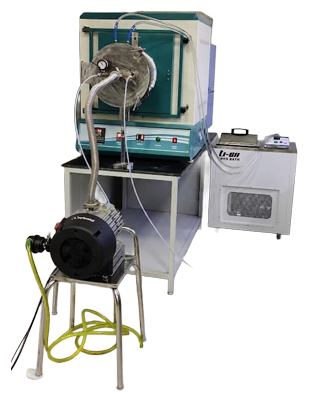
What is a Vacuum Furnace?
A Vacuum Furnace is a specialized high-temperature heating system designed to heat materials inside an enclosed chamber from which air and other gases are evacuated using a suitable vacuum pumping system.
By reducing the presence of atmospheric gases during heating, vacuum processing can help minimize oxidation and unwanted surface reactions in compatible materials. It is used for processes such as annealing, sintering, brazing, degassing and specialized heat treatment.
Unlike conventional furnaces that operate in ambient air, a Vacuum Furnace incorporates a sealed chamber, vacuum connections and a pumping arrangement to establish the required operating environment.
Shrinitha Scientific manufactures Laboratory Vacuum Furnaces with temperature capabilities from 1000°C to 1650°C, suitable for high-temperature research and controlled thermal processing.
Vacuum Furnace
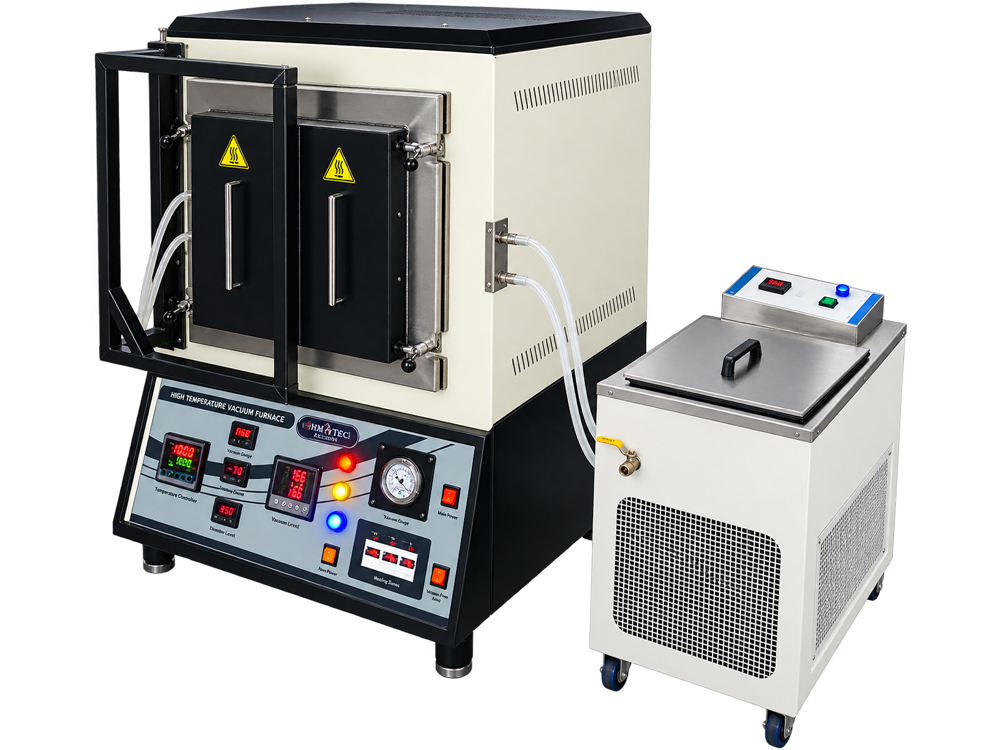
Key Features of Vacuum Furnace
- High-temperature operating capability from 1000°C to 1650°C, depending on model.
- Designed for reduced-pressure thermal processing.
- Suitable for vacuum heat treatment and annealing.
- Suitable for sintering and brazing applications.
- Electrically heated furnace chamber.
- Vacuum-compatible chamber construction.
- Suitable high-temperature insulation and heating elements.
- Digital temperature indication and control.
- Programmable temperature control available as per model.
- Vacuum pumping system selected according to application requirements.
- Optional controlled gas backfilling arrangement.
- Suitable for laboratory samples and selected industrial components.
- Customizable chamber dimensions and working volume.
- Suitable for research, development and specialized material processing.
Technical Specifications of Vacuum Furnace
| Parameter | Specification |
|---|---|
| Product Name | Laboratory Vacuum Furnace |
| Furnace Type | Electrically Heated Vacuum Furnace |
| Temperature Range | 1000°C to 1650°C |
| Heating System | Electrical Resistance Heating |
| Heating Elements | Selected according to operating temperature and model |
| Chamber | Vacuum-compatible chamber |
| Temperature Control | Digital / PID-based control, as per model |
| Temperature Programming | Available as per model |
| Temperature Sensor | Suitable thermocouple or sensor, depending on configuration |
| Vacuum System | Mechanical / other suitable pumping arrangement |
| Vacuum Level | Model- and pump-dependent |
| Atmosphere | Vacuum / optional compatible protective gas |
| Gas Backfilling | Available as per configuration |
| Heating Zones | Single-zone or customized multi-zone arrangement |
| Chamber Capacity | Customizable |
| Loading Arrangement | Horizontal / vertical / customized |
| Cooling Arrangement | Natural or engineered cooling arrangement, depending on model |
| Safety System | Selected protection and monitoring features, as per model |
| Power Supply | As per furnace configuration |
| Customization | Available according to application requirements |
Technical note: The specified temperature range represents the available capability across suitable models. Maximum operating temperature, working volume, ultimate vacuum level, temperature uniformity, heating rate and cooling arrangement must be confirmed for the selected furnace. Vacuum performance depends on chamber sealing, pumping equipment, material outgassing and operating conditions.
Working Principle of Vacuum Furnace
A Vacuum Furnace combines controlled electrical heating with evacuation of the furnace chamber to create the required processing environment.
1. Loading of Material
The material, sample or component is placed inside the furnace chamber using a suitable tray, fixture, crucible or loading arrangement.
The loading system is selected according to the dimensions, weight and nature of the material being processed.
2. Chamber Sealing
The furnace chamber is closed and sealed to establish the required vacuum-compatible environment.
Proper sealing is important for achieving and maintaining the intended pressure conditions during the process.
3. Evacuation of the Chamber
The vacuum pumping system removes air and other gases from the chamber until the required process pressure is reached.
The achievable vacuum depends on the selected pumping system, chamber condition, sealing quality and materials being processed.
4. Controlled Heating
Once the required chamber conditions are established, the heating system raises the temperature according to the selected heating profile.
A digital or programmable temperature controller regulates the heating process according to the selected model.
5. Thermal Treatment
The material is maintained at the required temperature for the specified duration. During this period, the intended thermal process, such as annealing, sintering, brazing or degassing, takes place.
6. Cooling and Unloading
After completion of the thermal cycle, the material is cooled according to the process requirements. The chamber is returned to an appropriate pressure condition before opening.
The treated material is then removed for inspection, testing or further processing.
Types of Vacuum Furnace
Shrinitha Scientific can provide different Vacuum Furnace configurations according to the required temperature, chamber dimensions, material and application.
1. Laboratory Vacuum Heat Treatment Furnace
A Laboratory Vacuum Heat Treatment Furnace is designed for thermal treatment of suitable metal components, alloys and laboratory materials under reduced-pressure conditions.
It can be used for selected annealing, stress-relief and heat-treatment studies where atmospheric contamination needs to be minimized.
Applications:
- Laboratory heat treatment
- Annealing of suitable metal samples
- Metallurgical research
- Stress-relief studies
- Material development
2. Vacuum Sintering Furnace
A Vacuum Sintering Furnace is designed for sintering compatible powders and compacted materials under reduced-pressure conditions.
The furnace configuration can be selected according to the material, sintering temperature, chamber requirements and atmosphere.
Applications:
- Ceramic sintering
- Powder metallurgy research
- Advanced material development
- Specialized component processing
- Laboratory sintering experiments
3. Vacuum Annealing Furnace
A Vacuum Annealing Furnace is used for thermal treatment of suitable materials under reduced-pressure conditions.
Vacuum annealing can be useful where oxidation control, degassing or controlled thermal treatment is required.
Applications:
- Metal and alloy annealing
- Material structure studies
- Stress-relief treatment
- Semiconductor material research
- Specialized laboratory heat treatment
4. Vacuum Brazing Furnace
A Vacuum Brazing Furnace is designed for joining compatible components using a suitable brazing filler material under vacuum conditions.
The required brazing temperature, chamber arrangement and heating profile depend on the materials and filler metal being used.
Applications:
- Brazing research
- Metal component joining
- Heat exchanger component development
- Specialized engineering components
- Material joining studies
5. Vacuum Tube Furnace
A Vacuum Tube Furnace combines a tubular heating arrangement with vacuum-compatible connections and suitable pumping equipment.
This configuration is useful for laboratory processes involving small samples, tubular reactors or compatible substrates.
Applications:
- Material synthesis
- Thin-film research
- Controlled-atmosphere experiments
- High-temperature material treatment
- Laboratory research
6. Customized High-Temperature Vacuum Furnace
Customized Vacuum Furnaces can be designed according to chamber size, loading arrangement, temperature capability, vacuum requirements and the nature of the material being processed.
Options can include horizontal or vertical loading, specialized heating arrangements, gas backfilling and application-specific temperature control.
Applications of Vacuum Furnace
Laboratory Vacuum Furnaces are used in research and industrial applications where high-temperature processing under reduced-pressure conditions is required.
1. Vacuum Heat Treatment
Used for selected heat-treatment processes involving suitable metals, alloys and engineering materials.
Applications include controlled thermal treatment, annealing and specialized metallurgical studies.
2. Vacuum Annealing
Suitable for thermal treatment of compatible metals, alloys and other materials where reduced exposure to atmospheric gases is beneficial.
3. Vacuum Sintering
Used for sintering compatible metal powders, ceramic powders and advanced materials under selected reduced-pressure conditions.
4. Vacuum Brazing
Suitable for brazing research and joining applications involving compatible metals and brazing filler materials.
5. Degassing and Devolatilization
Vacuum heating can assist in removing adsorbed gases, moisture or volatile substances from compatible materials under appropriate process conditions.
6. Ceramic Material Processing
Used for selected high-temperature ceramic processing applications, including sintering and material development.
7. Metallurgical Research
Suitable for research involving alloys, metal samples, phase transformation and material behaviour under controlled thermal conditions.
8. Semiconductor and Electronic Materials
Vacuum-compatible thermal processing can be used for suitable electronic materials, substrates and semiconductor research applications.
9. Advanced Material Development
Suitable for high-temperature processing of advanced materials, specialized compounds and selected research samples.
10. Academic and Industrial R&D
Used in universities, engineering laboratories, material research centres and industrial process-development facilities.
Advantages of Vacuum Furnace
Reduced Oxidation During Heating
Removing air from the chamber can help reduce oxidation of compatible materials during thermal processing. The actual result depends on the material, residual gases and achieved vacuum conditions.
Controlled Thermal Environment
The combination of temperature control and chamber-pressure management supports specialized heating processes that require more than ordinary ambient-air heating.
Suitable for High-Temperature Processing
With temperature capabilities from 1000°C to 1650°C, suitable configurations can support a range of high-temperature research and material-processing applications.
Reduced Atmospheric Contamination
Vacuum processing can reduce exposure to atmospheric gases and help limit unwanted reactions during suitable processes.
Flexible Processing Options
Depending on the model, the furnace can be configured for vacuum operation or compatible protective-gas backfilling.
Programmable Temperature Control
Programmable control, where provided, allows users to define heating and holding cycles for repeatable laboratory experiments.
Multiple Application Possibilities
The furnace can be used for suitable annealing, sintering, brazing, degassing, heat treatment and advanced materials research.
Customizable Furnace Design
Chamber dimensions, heating arrangement, loading configuration, vacuum equipment and control options can be selected according to the process requirement.
Vacuum Pumping System
The vacuum pumping system is a key component of a Vacuum Furnace. It removes gases from the chamber and helps establish the pressure conditions required for the selected thermal process.
The pumping arrangement should be selected according to the required vacuum level, chamber volume, process temperature and material outgassing characteristics.
Depending on the model, the vacuum system may incorporate:
- Mechanical vacuum pump
- Rotary vane vacuum pump
- Roots pumping arrangement
- Diffusion or turbomolecular pumping system, where required
- Vacuum gauge
- Vacuum isolation valves
- Vacuum piping and connections
- Chamber pressure monitoring
- Gas backfilling valves
- Customized vacuum control panel
The attainable vacuum level is dependent on the complete system design and should be confirmed for the selected furnace configuration.
Temperature Control and Monitoring
Temperature control is essential for achieving the desired thermal treatment in a Vacuum Furnace.
Shrinitha Scientific can provide suitable digital or programmable temperature-control systems depending on the selected model.
Possible features include:
- Digital temperature display
- PID-based temperature regulation
- Programmable heating cycles
- Temperature ramp and holding control
- Suitable thermocouple arrangement
- Independent heating-zone control, where specified
- Over-temperature protection
- Temperature alarms
- Process monitoring
- Data logging, where required
The temperature sensor and control arrangement should be selected according to the operating temperature, furnace construction and intended process.
Atmosphere Control and Gas Backfilling
Some vacuum processes require the chamber to be backfilled with a protective gas after evacuation or during selected stages of the thermal cycle.
Depending on the application, suitable gas provisions can include:
- Nitrogen gas connection
- Argon gas connection
- Gas inlet and outlet arrangement
- Gas flow meter
- Gas regulator
- Gas backfilling valves
- Gas purging arrangement
- Pressure monitoring
- Customized gas-control panel
The suitability of a gas depends on the process material, temperature, chamber construction and chemical compatibility.
Vacuum operation does not automatically make every process gas safe. Reactive, flammable or toxic gases require suitable engineering controls and a specifically designed gas-handling system.
Optional Accessories and Customization
Shrinitha Scientific can provide suitable accessories and customized features depending on the selected model and process requirements.
| Accessory / Option | Purpose |
|---|---|
| Vacuum Pumping System | Evacuates the furnace chamber |
| Vacuum Gauge | Monitors chamber pressure |
| Vacuum Valves | Controls evacuation and isolation |
| Gas Backfilling System | Introduces compatible protective gases |
| Gas Flow Meter | Indicates gas flow |
| Gas Regulator | Regulates gas supply |
| Programmable Temperature Controller | Supports programmed heating cycles |
| Data Logger | Records selected process parameters |
| Customized Sample Tray | Supports material during processing |
| High-Temperature Crucible | Holds suitable samples |
| Multi-Zone Heating | Supports different temperature regions |
| Water-Cooling Arrangement | Available where required by system design |
| Customized Chamber | Accommodates specific material and loading requirements |
All optional features are subject to model compatibility and confirmation of the intended operating conditions.
Why Choose Shrinitha Scientific Vacuum Furnace?
Shrinitha Scientific provides laboratory furnace solutions for controlled high-temperature processing and material research.
- Manufacturer and exporter of laboratory furnaces in India.
- Vacuum Furnace configurations with temperature capability from 1000°C to 1650°C.
- Application-focused furnace design.
- Suitable for vacuum heat treatment, annealing, sintering and brazing research.
- Options for different chamber dimensions and loading arrangements.
- Vacuum pumping systems selected according to process requirements.
- Temperature control and programming options.
- Controlled gas backfilling provisions for compatible configurations.
- Suitable for academic, laboratory and industrial R&D applications.
- Technical assistance for application-specific furnace selection.
Our aim is to provide furnace configurations suited to the user's actual thermal-processing, vacuum and laboratory requirements.
Vacuum Furnace Manufacturer & Exporter in India
Shrinitha Scientific manufactures and exports Laboratory Vacuum Furnaces with temperature capabilities from 1000°C to 1650°C for high-temperature material processing, vacuum heat treatment, annealing, sintering, brazing and specialized laboratory research.
Our furnace configurations are designed to address different chamber sizes, heating requirements, vacuum conditions and application-specific processing needs.
For a Laboratory Vacuum Furnace in India, contact Shrinitha Scientific with your required operating temperature, vacuum level, material details and chamber dimensions to discuss a suitable furnace solution.
Frequently Asked Questions (FAQ)
1. What is a Vacuum Furnace?
A Vacuum Furnace is a high-temperature furnace that heats materials inside an evacuated chamber to reduce the presence of air and other gases during processing.
2. What is the operating temperature range of Shrinitha Scientific Vacuum Furnace?
Shrinitha Scientific manufactures Vacuum Furnace configurations with temperature capabilities ranging from 1000°C to 1650°C, depending on the selected model.
3. What is the main purpose of a Vacuum Furnace?
A Vacuum Furnace is used for processes such as heat treatment, annealing, sintering, brazing and degassing where reduced atmospheric exposure or controlled pressure conditions are required.
4. What is the difference between a Vacuum Furnace and a conventional furnace?
A conventional furnace generally heats materials in ambient air or a specified atmospheric environment. A Vacuum Furnace includes a sealed chamber and pumping system to reduce the pressure and remove gases during processing.
5. Which materials can be processed in a Vacuum Furnace?
Depending on the furnace configuration, suitable materials may include metals, alloys, ceramics, powders, advanced materials and selected electronic or semiconductor materials.
Material compatibility must be confirmed according to temperature, vacuum conditions and heating-system materials.
6. Can a Vacuum Furnace be used for sintering?
Yes. Vacuum Furnaces can be used for suitable sintering processes involving compatible powders and materials. The required temperature, vacuum level and holding time depend on the material and process.
7. Can the furnace be used for vacuum annealing?
Yes. Vacuum annealing is one of the common applications of vacuum thermal processing. The appropriate configuration depends on the material, operating temperature and required chamber conditions.
8. What vacuum level can the furnace achieve?
The attainable vacuum level depends on the selected pumping system, chamber design, sealing, temperature and material outgassing. The required vacuum specification should be confirmed before selecting the model.
9. Can the Vacuum Furnace operate under nitrogen or argon?
Suitable configurations can include gas backfilling arrangements for compatible gases such as nitrogen or argon. The gas supply and operating conditions must be selected according to the process.
10. Can the Vacuum Furnace be customized?
Yes. Chamber dimensions, heating elements, temperature control, vacuum pumping arrangement, loading system and optional gas provisions can be customized according to application requirements.
11. Is the Vacuum Furnace suitable for laboratory research?
Yes. Laboratory Vacuum Furnaces are suitable for academic institutions, research laboratories, material science facilities and industrial R&D centres performing high-temperature experiments.
12. How do I select the right Vacuum Furnace?
The following details help determine a suitable configuration:
- Required maximum operating temperature
- Required vacuum level
- Material and sample dimensions
- Required chamber capacity
- Heating and holding cycle
- Process atmosphere
- Batch size and loading arrangement
- Cooling requirements
- Intended application
Contact Shrinitha Scientific with these details to discuss the appropriate furnace configuration.