- PH: +91 8828443924
- Email: Response@ShrinithaFurnace.Com

Chemical Vapour Deposition Furnace (CVD Furnace)
Laboratory CVD Furnace Manufacturer & Exporter in India
Shrinitha Scientific is a manufacturer and exporter of Laboratory Chemical Vapour Deposition Furnaces (CVD Furnaces) in India, designed for controlled high-temperature material processing and thin-film research. Our CVD Furnace is designed for operation up to 1200°C, providing a controlled heating environment for laboratory-scale deposition, material synthesis, coating, and advanced research applications.
A CVD furnace combines a high-temperature tubular heating chamber with a suitable process tube and controlled gas-delivery arrangement. During a CVD process, selected precursor gases are introduced into the heated reaction zone, where thermal reactions can result in the formation of a solid material or thin coating on a suitable substrate. Laboratory CVD systems commonly incorporate controlled gas flow and, depending on configuration, vacuum or pressure-control components.
Shrinitha Scientific develops CVD furnace configurations according to the required temperature, tube dimensions, heating-zone length, gas-handling requirements, and research application.
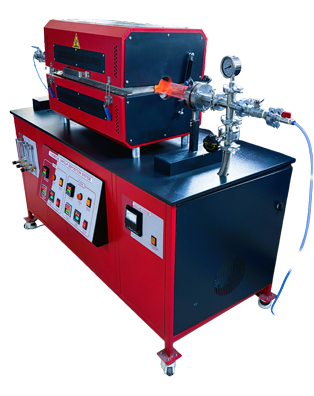
What is a Chemical Vapour Deposition Furnace?
A Chemical Vapour Deposition Furnace, commonly called a CVD Furnace, is a specialized laboratory heating system used to conduct chemical vapour deposition and related high-temperature processes.
The furnace heats a process tube to the required temperature while controlled gases or vapour-phase precursors are passed through the reaction zone. Under suitable process conditions, the precursor material can react or decompose and deposit a solid layer on a substrate.
A CVD furnace can therefore be used for research involving thin films, coatings, nanomaterials, carbon-based materials, and other advanced materials. Laboratory CVD systems may incorporate gas-flow controllers, gas mixers, vacuum pumps, sealed process tubes, and programmable heating zones depending on the process requirements.
Types of Laboratory CVD Furnace
Chemical Vapour Deposition Furnace (CVD Furnace)
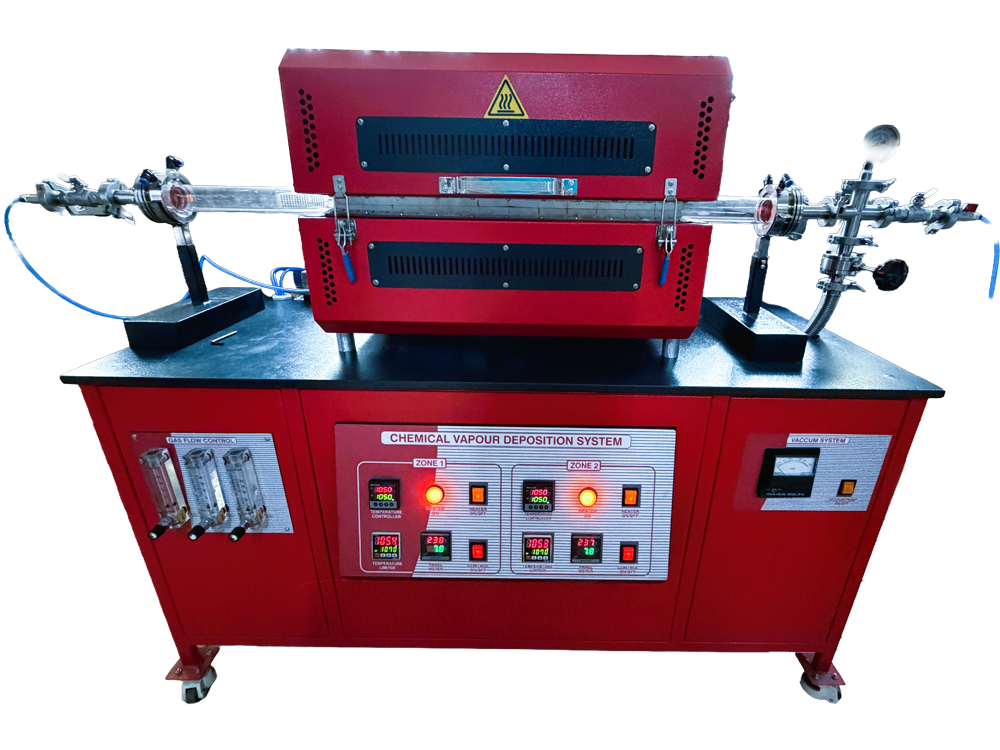
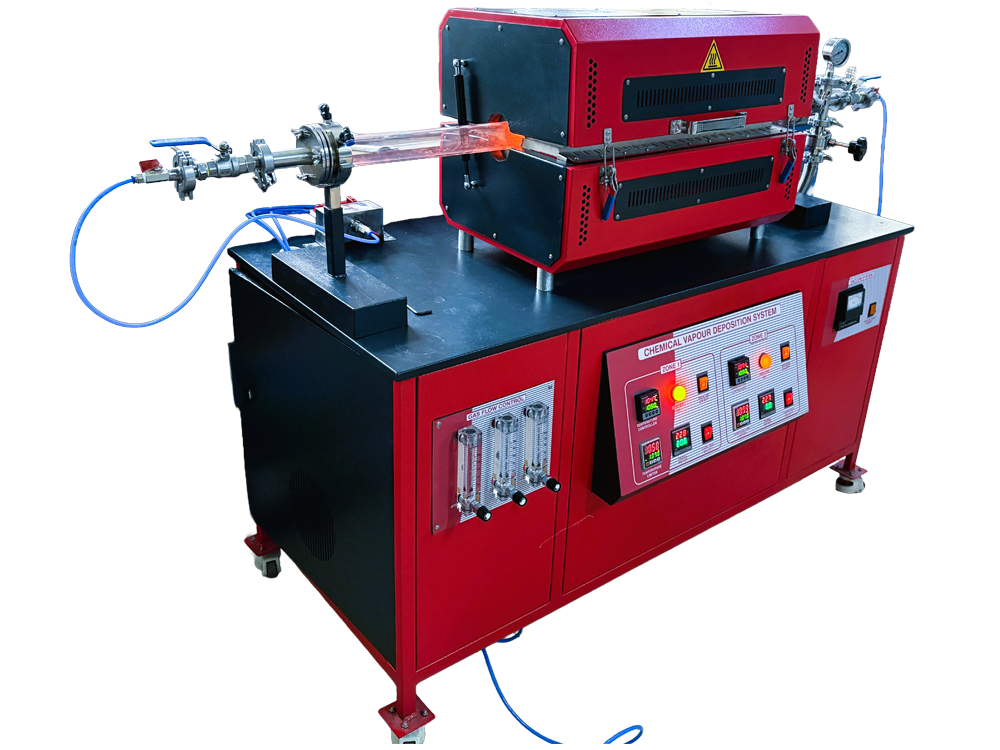
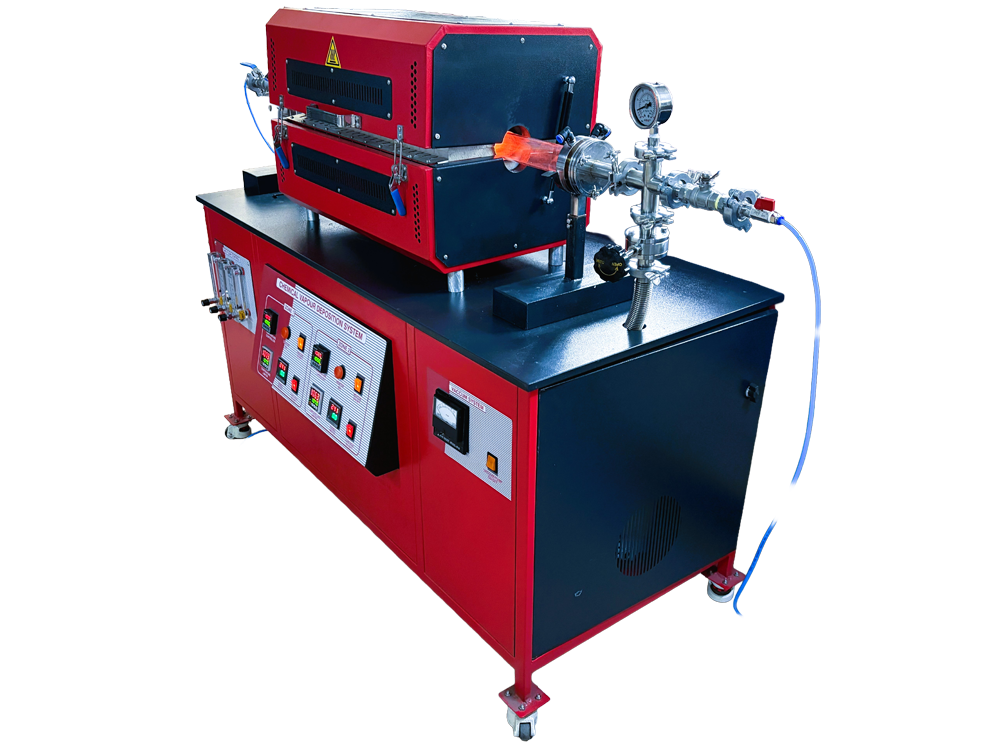
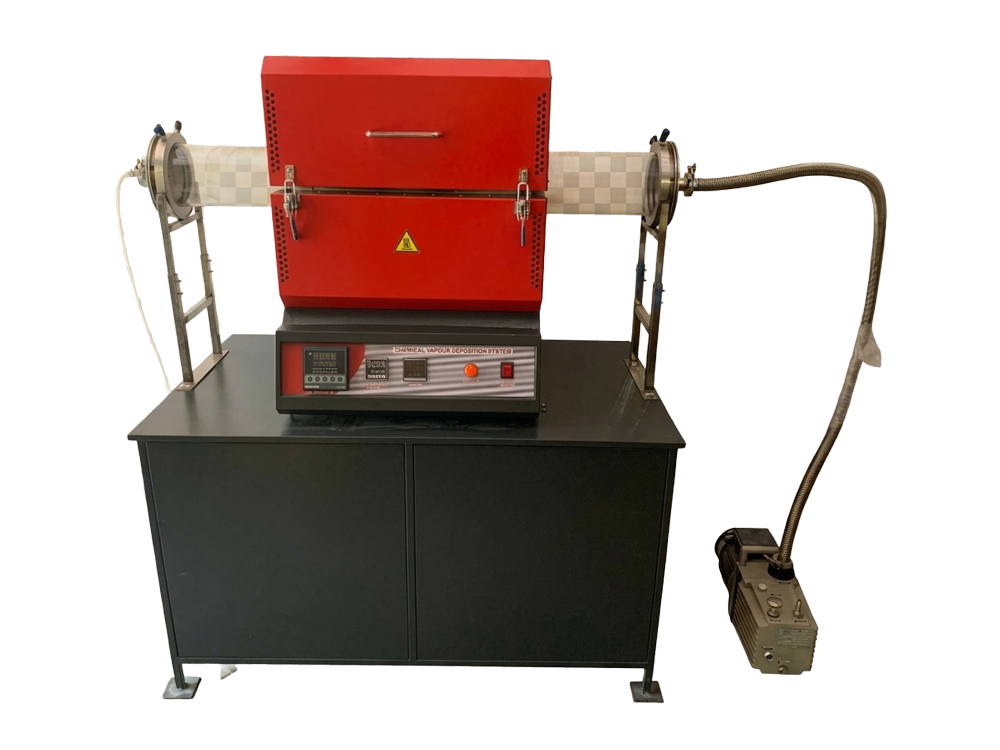
Key Features of Laboratory CVD Furnace
- Designed for high-temperature CVD research up to 1200°C.
- Electrically heated tubular furnace construction.
- Suitable for controlled-atmosphere material processing.
- Compatible with suitable quartz or high-temperature ceramic process tubes.
- Digital temperature control for precise furnace operation.
- Programmable temperature profiles according to the selected controller.
- Gas inlet and outlet arrangements for process-gas circulation.
- Optional multi-channel gas mixing and flow-control systems.
- Optional vacuum arrangement for suitable CVD processes.
- Single-zone or multi-zone heating configurations can be considered.
- Heating-zone length can be customized according to the application.
- Process tube diameter and length can be selected according to sample requirements.
- Suitable for laboratory-scale thin-film and material synthesis research.
- Customizable configuration for specific experimental requirements.
Gas-flow management is a common part of laboratory CVD furnace systems, with some configurations using multiple gas channels, gas mixing, and vacuum equipment to establish controlled process conditions.
Technical Specifications
| Parameter | Specification |
|---|---|
| Product Name | Laboratory Chemical Vapour Deposition Furnace |
| Common Name | Laboratory CVD Furnace |
| Manufacturer | Shrinitha Scientific |
| Maximum Temperature | Up to 1200°C |
| Heating System | Electric |
| Furnace Type | Tubular CVD Furnace |
| Temperature Controller | Digital PID / Programmable Controller |
| Heating Zones | Single Zone / Multi-Zone, as required |
| Process Tube | Quartz / Alumina or other suitable material |
| Gas System | Gas Inlet & Outlet Arrangement |
| Gas Flow Control | Optional Flow Meter / Mass Flow Controller |
| Gas Mixing | Optional Multi-Gas Mixing System |
| Vacuum System | Optional, according to process requirements |
| Heating Zone | Customizable |
| Tube Diameter | Customizable according to application |
| Tube Length | Customizable |
| Atmosphere | Controlled Process Atmosphere |
| Safety | Over-Temperature Protection, as configured |
| Power Supply | As per furnace model |
| Customization | Available |
Note: The actual tube material, gas-control system, vacuum level, number of heating zones, temperature uniformity, heating rate, and continuous operating temperature should be finalized according to the selected CVD configuration and process requirements.
How Does a CVD Furnace Work?
1. Substrate Placement
The substrate or sample is positioned inside a suitable process tube within the furnace's reaction zone.
2. Furnace Heating
The furnace is heated to the required process temperature using its electrical heating system and temperature controller.
3. Gas Introduction
Selected process gases or vapour-phase precursors are introduced through the gas inlet system at controlled flow rates.
4. Reaction Zone
The gases pass through the heated region of the tube. At the appropriate temperature and process conditions, the precursor can react or decompose.
5. Material Deposition
The resulting solid material deposits onto the prepared substrate or suitable surface, forming a layer or coating.
6. Exhaust
Unreacted gases and gaseous reaction products leave the reaction tube through the exhaust arrangement.
Applications of Laboratory CVD Furnace
Shrinitha Scientific Laboratory CVD Furnaces can be used for a range of advanced research applications.
Thin Film Deposition
For laboratory research involving deposition of thin layers onto suitable substrates.
Graphene Research
Suitable for selected research processes involving graphene and carbon-based materials.
Carbon Nanotube Research
Can be used for experimental synthesis of carbon nanotubes under appropriately designed process conditions.
Nanomaterial Synthesis
Suitable for thermal and vapour-phase synthesis studies involving selected nanomaterials.
Advanced Material Research
Used for investigating new materials and their thermal processing characteristics.
Surface Coating Research
Can support laboratory studies involving deposition of protective, functional, or experimental coatings.
Semiconductor Research
Suitable for selected deposition and material-processing experiments in semiconductor research.
Ceramic Research
Can be used for selected high-temperature coating and material-development studies.
Battery Material Research
CVD systems can support research involving selected carbon materials and advanced electrode-related materials.
Academic Research
Suitable for universities, research institutes, engineering laboratories, and educational facilities conducting advanced material research.
CVD tube-furnace systems are used in research areas including graphene, nanotubes, thin-film preparation, battery research, and advanced material processing.
Advantages of Laboratory CVD Furnace
Controlled Thermal Environment
The tubular furnace provides a defined heated reaction region for laboratory-scale deposition and material-processing experiments.
Controlled Gas Atmosphere
Suitable gas-flow arrangements allow the process atmosphere to be established according to the requirements of the selected experiment.
High-Temperature Operation
A maximum temperature of 1200°C provides a broad thermal range for laboratory CVD and related material-processing studies.
Flexible Configuration
Tube diameter, heating-zone length, number of heating zones, gas connections, and other components can be selected according to the application.
Programmable Heating
A programmable temperature controller can provide controlled heating and holding cycles where supported by the selected configuration.
Vacuum Compatibility
A vacuum system can be incorporated for processes that require reduced pressure, provided the complete furnace and process assembly are designed for vacuum operation.
Research-Oriented Design
The furnace can be configured for laboratory-scale experiments involving thin films, coatings, nanomaterials, and advanced materials.
Gas Flow & Process Control
Gas control is an important part of a CVD system. Depending on the application, the furnace can be configured with:
- Gas inlet and outlet connections
- Individual gas-flow meters
- Mass Flow Controllers (MFCs)
- Multi-channel gas mixer
- Gas switching arrangement
- Inert-gas purge line
- Vacuum-compatible piping
- Pressure measurement
- Exhaust arrangement
The number of gas channels and flow-control components should be selected according to the CVD chemistry and process requirements. Commercial laboratory CVD systems demonstrate configurations ranging from basic gas-flow management to multi-channel mass-flow control and vacuum systems.
Optional Accessories
Shrinitha Scientific can offer suitable accessories according to the selected CVD furnace configuration:
- Quartz process tube
- Alumina process tube
- Stainless-steel vacuum flanges
- Gas inlet and outlet fittings
- Gas flow meters
- Mass Flow Controllers
- Multi-gas mixing system
- Vacuum pump
- Vacuum gauge
- Vacuum valves
- Gas purge arrangement
- Water-cooled flange, where required
- Programmable temperature controller
- Multi-zone temperature control
- Temperature data logger
- Customized sample holders
- Process tube support arrangement
Accessory selection should be based on the required process temperature, gas chemistry, pressure, tube material, and experimental configuration.
Why Choose Shrinitha Scientific?
High-Temperature CVD Capability:
Our CVD Furnace is designed for laboratory applications requiring temperatures up to 1200°C.
Application-Based Design:
The furnace can be configured around the customer's required process tube, heating zone, gas system, and experimental setup.
Controlled Processing:
Temperature control and suitable gas-management arrangements help establish repeatable laboratory process conditions.
Flexible Configuration:
Single-zone, multi-zone, gas-flow, and vacuum-compatible arrangements can be considered according to the application.
Research-Focused Equipment:
Our CVD Furnaces are intended for laboratories, universities, research institutions, and industrial R&D facilities.
Manufacturer & Exporter in India:
Shrinitha Scientific provides laboratory furnace solutions for customers in India and international markets.
Chemical Vapour Deposition Furnace Manufacturer & Exporter in India
Shrinitha Scientific is a manufacturer and exporter of Laboratory Chemical Vapour Deposition Furnaces (CVD Furnaces) in India, offering high-temperature laboratory systems designed for controlled material processing and deposition research up to 1200°C.
Our CVD Furnace solutions can be configured with suitable process tubes, heating zones, gas-flow systems, temperature controllers, and optional vacuum equipment according to the intended application.
Whether the requirement is for thin-film research, graphene studies, carbon material development, nanomaterial synthesis, surface coating research, or other CVD-related laboratory applications, Shrinitha Scientific can develop a furnace configuration around the required process conditions.
Contact Shrinitha Scientific to discuss your required temperature, tube size, heating-zone length, gas channels, vacuum requirement, and application. We can provide a suitable technical configuration and quotation.
Frequently Asked Questions
1. What is a Chemical Vapour Deposition Furnace?
A Chemical Vapour Deposition Furnace is a specialized high-temperature furnace used to conduct CVD processes in which gaseous precursors react or decompose under controlled conditions and form a solid deposit on a suitable substrate.
2. What is the maximum temperature of Shrinitha Scientific CVD Furnace?
Shrinitha Scientific manufactures Laboratory CVD Furnaces with a temperature capability of up to 1200°C.
3. What is a CVD furnace used for?
It can be used for laboratory research involving thin-film deposition, surface coatings, graphene, carbon nanotubes, nanomaterials, advanced materials, and other compatible CVD processes.
4. Can multiple gases be used?
Yes. A suitable gas-management system can be configured with multiple gas channels, flow meters, or mass-flow controllers according to the requirements of the CVD process.
5. Can the CVD Furnace operate under vacuum?
A suitable vacuum-compatible configuration can be provided for processes requiring reduced pressure. The furnace, tube, seals, valves, piping, and pumping system must all be selected for the required operating conditions.
6. What type of tube is used in a CVD Furnace?
Quartz and alumina are commonly considered for laboratory tubular furnace applications, but the appropriate tube material depends on the process temperature, gas chemistry, pressure, and substrate arrangement.
7. Can the CVD Furnace be customized?
Yes. Shrinitha Scientific can discuss customization of heating-zone length, tube diameter, number of heating zones, gas connections, gas-flow control, vacuum arrangement, and temperature-control system.
8. Who uses Laboratory CVD Furnaces?
CVD Furnaces are used by universities, research laboratories, material science departments, nanotechnology laboratories, semiconductor research facilities, chemical laboratories, and industrial R&D centres.